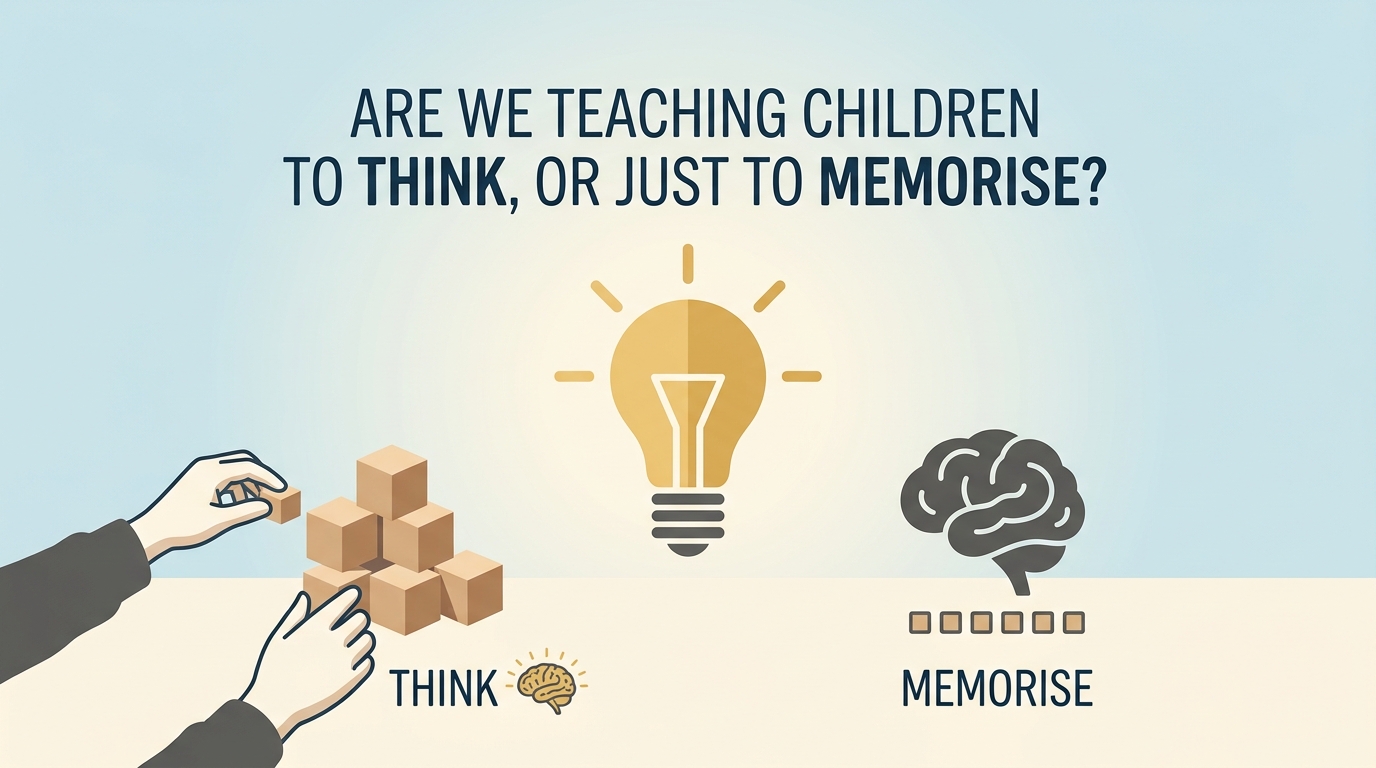
Are We Teaching Children to Think, or Just to Memorise?
A child can memorize a definition, reproduce a formula and score well on a test. But what happens when the answer is not in the textbook?
Can they ask the right question?
Can they explain why they think something is true?
Can they compare two ideas, recognize weak evidence, consider another point of view and reach a reasoned conclusion?
These questions sit at the heart of critical thinking skills in children.
Education is not only about how much information a child can memorize. It is also about what they can do with that information. Modern learning increasingly places value on questioning, analysis, application, problem-solving and reflection rather than simple recall. Cambridge International similarly describes active learning as an approach that encourages learners to process, apply and engage deeply with ideas instead of passively receiving information. (Cambridge International Education blog)
For parents, this raises an important question:
Are we preparing children to give the right answer, or helping them understand how to find one?
Why Memorizing Still Matters
The answer is not to stop teaching children facts.
Knowledge matters.
A child cannot analyze a scientific problem without understanding basic science. They cannot discuss a historical event without knowing what happened. They cannot solve a mathematical problem without understanding mathematical concepts.
The difference is what happens after knowledge is acquired.
Memorization can help a learner build a foundation. Critical thinking helps them use that foundation.
For example, a student may memorize that plants need sunlight to grow. A thinking student might go further:
- What happens if a plant receives very little sunlight?
- Would every plant respond in the same way?
- How could we test this?
- What evidence would support our conclusion?
- Are there other factors affecting growth?
The shift is small, but important.
Instead of asking only “What is the answer?”, learning begins to include “How do we know?”
What Are Critical Thinking Skills in Children?
Critical thinking is not simply being clever or having an opinion.
It involves examining information carefully, asking relevant questions, considering evidence, recognising different perspectives and reaching conclusions through reason.
Cambridge International describes critical thinking and reasoning as transferable skills that can help students analyze unfamiliar problems, evaluate possible solutions and make informed decisions. (Cambridge International)
For younger learners, these abilities can begin with simple classroom habits:
Questioning:
Why did this happen?
Comparing:
How are these two ideas different?
Explaining:
What makes you think that?
Investigating:
How could we find out?
Evaluating:
Which answer has stronger evidence?
Reflecting:
Would you change your answer after learning something new?
These questions do not require a separate “critical thinking lesson”. They can become part of everyday learning.
The Difference Between Knowing and Understanding
Imagine two students have learned the same science topic.
The first student can recall the definition perfectly.
The second student can explain the definition, connect it to an example, identify a possible exception and use the idea to explain something they have observed.
Both students have learned.
But the second student has begun to use knowledge.
This distinction is important because genuine understanding allows children to transfer what they have learned to unfamiliar situations.
At Schola Nova’s Primary School programme, learning is designed to combine academic foundations with hands-on activities, projects and real-world applications, while encouraging curiosity, communication and critical thinking. (Schola Nova)
The goal is not to make every lesson complicated.
Sometimes it simply means giving a child enough space to explain their thinking.
The Power of Asking “Why?”
One of the simplest ways to develop critical thinking skills in children is to change the questions adults ask.
Instead of:
“What is the answer?”
Try:
“How did you reach that answer?”
Instead of:
“Is this correct?”
Try:
“What evidence supports it?”
Instead of:
“Did you understand?”
Try:
“Can you explain it in your own words?”
These questions encourage children to make their thinking visible.
They also help teachers identify whether a student genuinely understands a concept or has simply memorised a response.
A good question can sometimes teach more than another explanation.
Give Children Problems Without Immediate Answers
Children need opportunities to struggle productively.
That does not mean leaving them confused or unsupported. It means giving them enough time to explore a problem before immediately providing the solution.
Consider a simple classroom challenge:
“You have three materials. Which one would make the strongest bridge?”
Rather than telling students which material works best, a teacher can ask them to:
- Make a prediction.
- Explain their reasoning.
- Test the materials.
- Record what happens.
- Compare the results.
- Decide whether their original prediction was correct.
- Explain what they learned.
The final answer is only one part of the activity.
The thinking process is the real lesson.
This type of active learning encourages students to process and apply ideas rather than simply copy information. (Cambridge International Education blog)
Let Children Make Mistakes and Reconsider
A classroom where every mistake is treated as failure can make children afraid to think independently.
If students believe there is only one acceptable answer and every wrong attempt will be criticised, they may eventually stop taking intellectual risks.
Instead, mistakes can become opportunities to ask:
What happened?
Why did it happen?
What could we try differently?
What did we learn from the result?
Reflection turns an incorrect answer into useful information.
Cambridge International’s guidance on learning strategies also highlights the value of helping students evaluate which approaches worked, consider what they could change and become more aware of how they learn. (Cambridge International Education blog)
That is an important step towards independent learning.
Teach Children to Look for Evidence
Children encounter information everywhere.
Books, videos, websites, conversations and social media can all present claims that sound convincing.
The ability to ask “How do we know?” therefore becomes increasingly important.
For an age-appropriate classroom discussion, a teacher might present a statement and ask students:
- What is the claim?
- What evidence supports it?
- Is the evidence reliable?
- Could there be another explanation?
- What information is missing?
- Would another source agree?
These questions help children understand that information should not automatically be accepted simply because it is presented confidently.
Cambridge International has similarly highlighted the importance of critical engagement with information and checking sources and perspectives. (Cambridge International Education blog)
Different Answers Can Lead to Better Thinking
A strong classroom does not always need every student to reach the same conclusion immediately.
Sometimes the most valuable discussion begins when students disagree.
A teacher can ask:
“Why do you think that?”
Then:
“Who sees it differently?”
And finally:
“What evidence could help us decide?”
This teaches children that disagreement does not have to become an argument.
It can become an investigation.
Schola Nova’s Secondary School programme specifically emphasises research, analysis, independent thinking, logical arguments, discussion and presentation skills. (Schola Nova)
These experiences help students move from simply expressing an opinion to explaining and supporting it.
Critical Thinking Should Not Stop at the Classroom Door
Parents can reinforce the same habits at home without turning everyday life into another lesson.
When a child watches something interesting, ask:
“What do you think happened?”
When they make a decision:
“Why did you choose that?”
When they disagree:
“What makes you think that?”
When they make a prediction:
“What would change your mind?”
Even everyday situations can encourage reasoning.
Planning a family outing can involve comparing options. Cooking can involve measurement and prediction. Reading a story can lead to questions about a character’s choices. Watching the news can create opportunities to discuss different perspectives.
The objective is not to interrogate children.
It is to make thoughtful conversation part of normal life.
From Classroom Thinking to Cambridge IGCSE
As students grow older, these habits become increasingly valuable across academic subjects.
At Schola Nova’s Cambridge IGCSE programme, students are encouraged to develop critical analysis, practical problem-solving, research, independent learning and communication alongside subject knowledge. (Schola Nova)
This approach matters because older students increasingly encounter questions that cannot be answered through memorisation alone.
They may need to interpret information, investigate a question, compare viewpoints, construct an argument or apply a concept to an unfamiliar situation.
Cambridge International also notes that effective curricula can develop higher-order cognitive skills through approaches such as research, group projects, presentations and active engagement in learning. (Cambridge International Education blog)
That is where the difference between memorising an answer and understanding how to reach an answer becomes especially clear.
Five Simple Ways Schools Can Build Better Thinkers
1. Ask More Open-Ended Questions
Questions with more than one possible starting point encourage students to explain, explore and justify their ideas.
2. Give Students Thinking Time
Not every child can produce a thoughtful response immediately. A few quiet moments can allow learners to organise their ideas.
3. Use Real Problems
Connecting concepts to practical situations helps students understand why their learning matters.
4. Encourage Evidence-Based Answers
Teach children to support conclusions rather than relying only on confidence or opinion.
5. Make Reflection Part of Learning
Ask students what worked, what did not and what they would change next time.
These small changes can gradually make classrooms more focused on understanding rather than repetition.
What Should Parents Look for in a School?
Parents comparing schools often look at examination results, curriculum options, facilities and extracurricular activities.
Those things matter.
But it is also worth asking:
- Do students have opportunities to ask questions?
- Are they encouraged to explain their reasoning?
- Do teachers welcome thoughtful discussion?
- Are students given opportunities to research?
- Can they work collaboratively?
- Are mistakes treated as part of learning?
- Do lessons connect knowledge with practical situations?
- Are children encouraged to become independent learners?
A school’s approach to these questions can reveal a great deal about how it views education.
At Schola Nova, the wider academic approach combines a student-centred environment with curiosity, inquiry, creativity and independent learning. The school’s stated goals include helping learners think critically and grow into confident, capable individuals. (Schola Nova)
The Goal Is Not More Questions. It Is Better Thinking.
Children will always need to memorize things.
They need facts.
They need vocabulary.
They need formulas, concepts, dates and definitions.
But education becomes more powerful when memorising is only the beginning.
The bigger question is what children can do with what they know.
Can they investigate?
Can they question?
Can they compare?
Can they explain?
Can they change their minds when new evidence appears?
Can they solve a problem they have never seen before?
These are the habits that help children become independent learners rather than simply successful answer-givers.
And perhaps that is one of the most important questions we can ask about education today:
Are we teaching children what to think, or giving them the tools to think for themselves?
Frequently Asked Questions
What are critical thinking skills in children?
Critical thinking skills help children question information, analyze ideas, consider evidence, compare perspectives, solve problems and reach reasoned conclusions.
Why is critical thinking important in education?
Critical thinking helps students apply knowledge to unfamiliar situations instead of relying only on memorised answers. It can support problem-solving, research, communication and independent learning.
How can teachers develop critical thinking in the classroom?
Teachers can use open-ended questions, practical problems, discussions, research tasks, evidence-based activities, reflection and opportunities for students to explain their reasoning.
Can parents develop critical thinking at home?
Yes. Parents can encourage thoughtful conversations by asking children why they reached a conclusion, what evidence supports an idea and whether they would change their view after learning something new.
Does critical thinking replace memorisation?
No. Knowledge and memory provide an important foundation. Critical thinking allows students to understand, evaluate and apply that knowledge.
How does Cambridge IGCSE support critical thinking?
Cambridge IGCSE combines subject knowledge with opportunities for critical analysis, problem-solving, research, independent learning and communication. (Schola Nova)
Final Thought
A child who memorises an answer may succeed on today’s question.
A child who understands how to think is better prepared for the questions we have not asked yet.
That is why meaningful education should make room for both knowledge and curiosity, accuracy and questioning, answers and exploration.
Because the ultimate goal is not simply to fill a child’s mind with information.
It is to help them learn how to use it.