
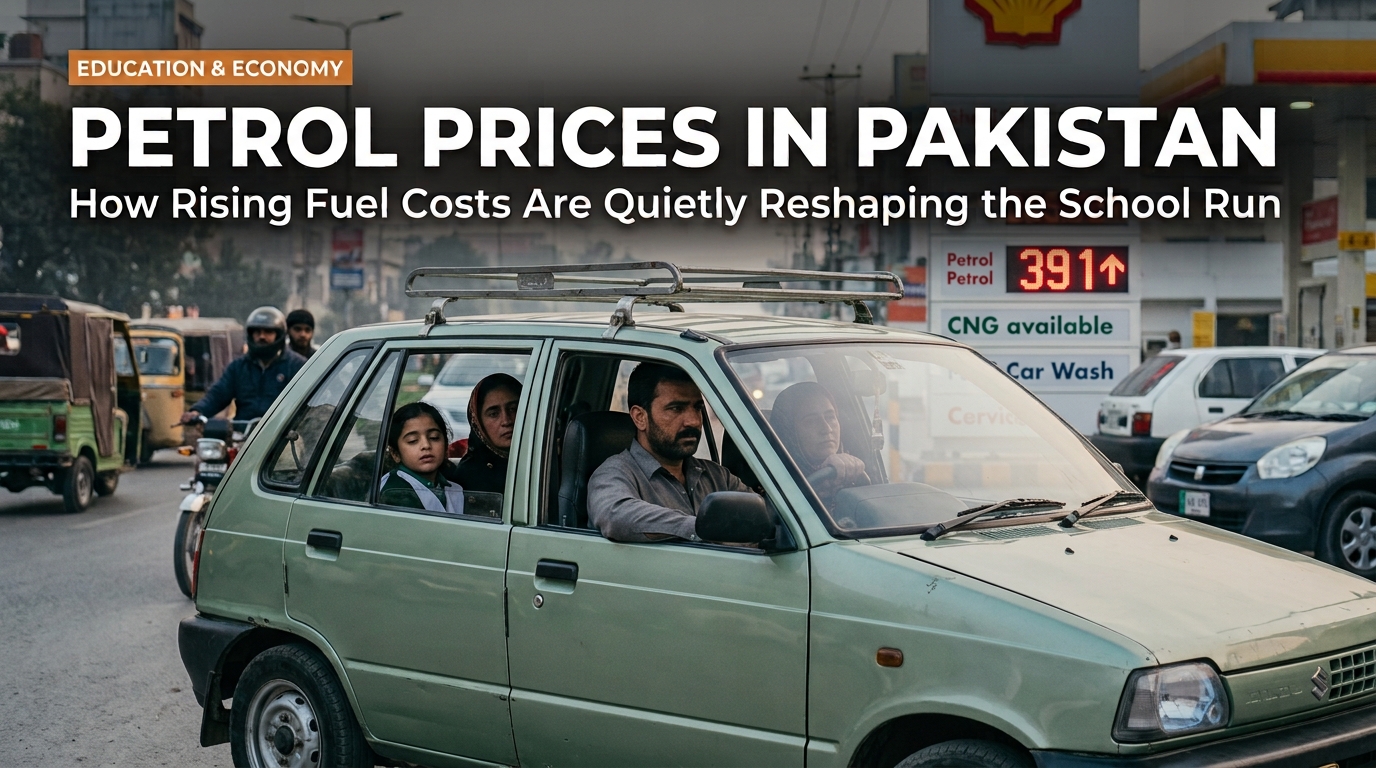
How rising fuel costs can affect school transport, family routines and the daily journey to school
There is a small, ordinary ritual that plays out in thousands of households every weekday morning. A parent checks the fuel gauge before leaving home, considers the day’s journeys and quietly works out whether the school run, office commute and evening errands can all be combined into fewer trips.
It sounds like a small calculation.
For many families, it is not.
The petrol prices Pakistan families face can become part of everyday household planning. The school journey is only one part of a family’s weekly travel, but when fuel costs change, parents may find themselves reconsidering routes, carpooling arrangements, after-school activities and other journeys.
As of 18 September 2026, petrol in Pakistan was priced at Rs390.79 per litre following the latest government revision. The Petroleum Division continues to publish regular petroleum-price notifications, reflecting how frequently fuel costs can change.
For parents, however, the important question is not only what petrol costs at the pump.
It is what that price means for the everyday school journey.
Why Petrol Prices in Pakistan Matter to the School Run
For a family that drives to school every day, fuel is a recurring household expense.
The school run may involve:
- Driving children to school in the morning
- Returning home or travelling to work
- Picking children up later in the day
- Attending after-school activities
- Travelling to tuition or other commitments
- Combining school journeys with shopping and errands
When the price of petrol changes, the effect can therefore extend beyond a single trip.
A family may start thinking more carefully about how many journeys it makes each week, whether two errands can be combined, or whether a shared school journey could reduce the number of individual car trips.
This does not mean that every family will make the same changes. Each household has different work schedules, locations, transport arrangements and responsibilities.
But the petrol prices Pakistan families experience can become another practical consideration in managing the school week.
Understanding Recent Petrol Price Changes in Pakistan
Petrol prices in Pakistan can change in response to factors including international oil prices, exchange-rate movements, taxes and the government’s petroleum-pricing mechanism.
The Ministry of Energy’s Petroleum Division publishes official notifications for petroleum-product prices. Its September 2026 updates show several price revisions over a short period, illustrating how quickly fuel costs can move.
For example, petrol was listed at Rs342.79 per litre on 1 September 2026. It subsequently increased through several revisions before being set at Rs390.79 per litre from 18 September.
For families, the significance is not simply the number on the price board.
It is the cumulative effect of paying for fuel across many journeys throughout the month.
The Hidden Cost of the Daily School Commute
School fees are visible expenses.
Fuel is different.
It can appear as a series of smaller transactions throughout the month, making its total impact less obvious until a family reviews its overall spending.
Consider a parent who drives to school twice a day while also travelling to work and completing household errands. The school journey may account for only part of the vehicle’s total monthly mileage, but it is a journey that usually cannot simply be removed from the family’s routine.
This is why rising fuel prices can create pressure in ways that are easy to overlook.
Parents may begin:
- Combining several errands into one journey
- Sharing school transport with trusted families
- Planning weekly travel more carefully
- Reviewing unnecessary car journeys
- Coordinating children’s activities on the same days
- Considering more efficient routes
These are practical household decisions rather than educational decisions, but they can still influence a family’s experience of the school week.
How Rising Fuel Costs Can Affect School Transport
The impact of fuel prices is not limited to families who drive their own cars.
School vans, private pick-and-drop services and other transport providers also have operating costs to manage. Fuel is one part of those costs.
When fuel prices rise, transport operators may need to review their fares depending on their routes, vehicle types, mileage and other expenses.
This means that families who rely on private transport may also feel the effect indirectly.
The exact impact will vary from one transport provider to another, so parents should always discuss current fares and arrangements directly with their transport provider.
For families considering shared transport, a trusted carpool can also reduce the number of individual journeys needed for the same school route.
What Parents Can Do to Manage the School Run
There is no single solution for every family.
Instead, small changes to everyday routines may help some households manage travel more efficiently.
1. Consider a Trusted Carpool
If another family lives nearby and follows a similar school schedule, sharing some school journeys may reduce the number of individual trips.
Parents should agree clearly on:
- Pickup and drop-off arrangements
- Timing
- Emergency contacts
- Responsibility for children during the journey
- Vehicle safety
- Changes to the arrangement
A carpool should always be based on trust, clear communication and appropriate child-safety considerations.
2. Combine Necessary Journeys
A school run can sometimes be combined with another essential journey.
For example, a parent travelling from school towards work may be able to complete a necessary errand on the same route rather than making a separate trip later.
The aim is not to make every journey complicated.
It is simply to avoid unnecessary additional driving where practical.
3. Plan After-School Activities Together
Children benefit greatly from sports, arts, clubs and other activities.
However, families with several weekly commitments may find that arranging activities on fewer days reduces the number of separate journeys.
This is particularly useful for families with more than one child attending different activities.
The goal should be sensible planning rather than reducing opportunities for children.
4. Review Your Regular Route
A shorter route is not automatically the most practical route, particularly in Islamabad traffic.
Parents can compare routes based on:
- Distance
- Traffic conditions
- Road safety
- Travel time
- Number of stops
- Fuel consumption
A slightly different route may sometimes reduce unnecessary mileage, although traffic conditions can change throughout the day.
5. Communicate with the School
When a family’s circumstances change, communication can make routines easier to manage.
A parent may need to explain a change in pickup arrangements, inform the school that another trusted adult will collect a child, or discuss a practical scheduling issue.
Keeping the school informed helps avoid confusion and supports a smoother daily routine.
How Schola Nova Thinks About the School Run
At Schola Nova, we recognise that a child’s education does not exist separately from family life.
Parents manage work, household responsibilities, children’s activities, travel and many other commitments alongside school.
That is why our relationship with families extends beyond lessons and report cards.
Schola Nova has been serving families in F-8, Islamabad since 1998. Our location in F-8/3 places the school within the established residential and commercial areas of Islamabad, making the daily journey a practical consideration for many families living in and around the area.
You can learn more about our academic programmes and how our school community supports students at different stages of their education.
A School’s Location Matters to Families
When parents choose a school, academic quality is naturally an important consideration.
But location also affects everyday family life.
A school that is closer to home, work or other regular destinations may reduce the time spent travelling each day. Over an entire academic year, these small differences can become meaningful parts of a family’s routine.
For parents in Islamabad, factors such as:
- Distance from home
- Traffic
- Daily travel time
- Transport availability
- School timings
- After-school commitments
- Family work schedules
can all form part of the practical decision-making process.
This is why choosing a school is not only about what happens inside the classroom.
It is also about how the school fits into family life.
Petrol Prices Pakistan and the Importance of Practical Planning
The conversation around petrol prices Pakistan often focuses on the price at the pump.
For families, the real question can be broader:
How does this change affect our everyday routine?
A rise in fuel costs may encourage families to plan routes more carefully, share journeys where appropriate, combine errands and reconsider how activities are scheduled.
These are practical habits that can also teach children something valuable.
They show children that families sometimes need to adapt when circumstances change.
A simple conversation about planning a journey can become an early lesson in responsibility, resourcefulness and practical decision-making.
What Children Can Learn from Everyday Changes
Children notice changes in family routines.
They may notice that parents are combining errands, planning journeys differently or discussing household expenses more carefully.
Parents do not need to burden children with adult financial concerns.
Instead, age-appropriate conversations can help children understand that families sometimes make thoughtful choices about how they use resources.
For younger children, this may be as simple as explaining:
“We are combining these two trips so we can save time and fuel.”
Older children can gradually learn about budgeting, planning and responsible use of resources.
These everyday conversations can support the broader life skills children develop throughout their education.
You can also explore Schola Nova’s Life Skills Programme to learn more about how practical skills form part of a child’s wider educational development.
The School Run Is About More Than Getting There
The journey to school is often treated as a simple logistical task.
But it is also part of a child’s daily experience.
The morning journey can be a time for:
- Conversation
- Listening
- Preparing mentally for the school day
- Discussing plans
- Sharing stories
- Building family connections
Even when parents are thinking about fuel consumption and traffic, the journey can still provide valuable time together.
A shorter or more efficiently planned commute does not have to mean a less meaningful one.
Sometimes, reducing unnecessary travel simply creates a calmer and more manageable morning.
Building a Supportive School Community
A strong school community is built through more than academic achievement.
It involves communication between teachers, students and parents.
At Schola Nova, we aim to maintain a close relationship with families so that parents feel comfortable communicating when practical circumstances affect their child’s routine.
Whether the issue involves transport arrangements, school activities, timings or another everyday concern, early communication can often prevent a small logistical issue from becoming a larger problem.
Our approach is rooted in the belief that Educating with Heart, Leading with Vision means understanding the whole child and the family supporting them.
How the School Journey Changes as Children Grow
A child’s travel needs can change significantly over the years.
Preschool
Younger children generally depend entirely on adults for their daily journey to and from school.
At this stage, parents often manage the entire transport routine.
Primary School
As children grow, families may become more comfortable with established carpool or transport arrangements, depending on their circumstances.
This can provide children with greater familiarity and consistency in their daily routine.
Explore the Schola Nova Primary School programme to learn more about this stage of learning.
Secondary School
Older students may gradually develop greater independence, depending on family decisions, transport availability and safety considerations.
Their schedules can also become more complex as academic and co-curricular commitments increase.
Schola Nova’s Secondary School programme supports students as they move towards greater academic responsibility.
Cambridge IGCSE
For students in the Cambridge IGCSE years, academic preparation becomes increasingly focused while students also develop independence, communication and wider learning skills.
You can explore the school’s Cambridge IGCSE programme for more information.
Managing Fuel Costs Without Losing What Matters
Rising fuel costs can make families reconsider some journeys, but children’s education and development should remain at the centre of planning.
Instead of removing meaningful activities altogether, families may be able to reorganise schedules.
For example:
- Grouping activities on the same day
- Sharing transport with trusted families
- Combining necessary errands
- Planning routes ahead
- Avoiding unnecessary additional journeys
- Communicating early about changes in routine
The right approach will be different for every household.
The important point is to find practical solutions that work for the family without unnecessarily limiting a child’s opportunities to learn, participate and grow.
A Practical Conversation for Parents
The latest petrol prices Pakistan families are experiencing are a reminder that the cost of education is not limited to tuition fees.
There are also transport, time and everyday logistical considerations.
Parents therefore have every reason to think about the complete picture when planning their child’s education.
At the same time, a school’s role is not to tell every family how to manage its household budget.
It is to create an environment where families can communicate openly and where practical concerns can be discussed respectfully.
At Schola Nova, that principle forms part of our wider commitment to building a close-knit school community.
Frequently Asked Questions
What are the current petrol prices in Pakistan?
As of 18 September 2026, petrol was set at Rs390.79 per litre. Petroleum prices can change frequently, so families should check the latest official notification from Pakistan’s Petroleum Division for the current rate.
Why do petrol prices in Pakistan affect school transport?
Families who drive children to school use fuel for regular journeys. Changes in fuel prices can therefore affect monthly transport spending. Private transport and pick-and-drop services may also face higher operating costs when fuel prices increase.
Can carpooling help families manage school transport costs?
Sharing school journeys with a trusted family may reduce the number of individual vehicle trips. Parents should agree clear arrangements and prioritise children’s safety.
How can parents reduce unnecessary school-run journeys?
Parents can consider combining errands, coordinating children’s activities, planning routes and sharing journeys where appropriate.
Does Schola Nova provide school transport?
Transport availability and arrangements can change, so parents should contact Schola Nova directly for the latest information rather than relying on outdated online information.
Where is Schola Nova located?
Schola Nova is located in F-8/3, Islamabad. Parents can visit the Schola Nova website to learn more about the school and its programmes.
How can parents apply to Schola Nova?
Parents can visit the school’s How to Apply page for information about the admissions process.
Looking Beyond the Petrol Pump
Fuel prices will continue to change, and families will continue to adapt their routines in different ways.
For parents, the school journey is only one part of a much bigger picture involving education, work, family responsibilities, activities and everyday life.
At Schola Nova, we believe a school should understand that bigger picture.
For families in and around Islamabad, choosing a school is not simply about classrooms and curriculum. It is also about finding an educational community that fits naturally into family life.
If you are looking for a school in Islamabad where academic learning, character development, life skills and a close school community come together, discover more about Schola Nova School, F-8, Islamabad.
Schola Nova — Learn to Lead.