
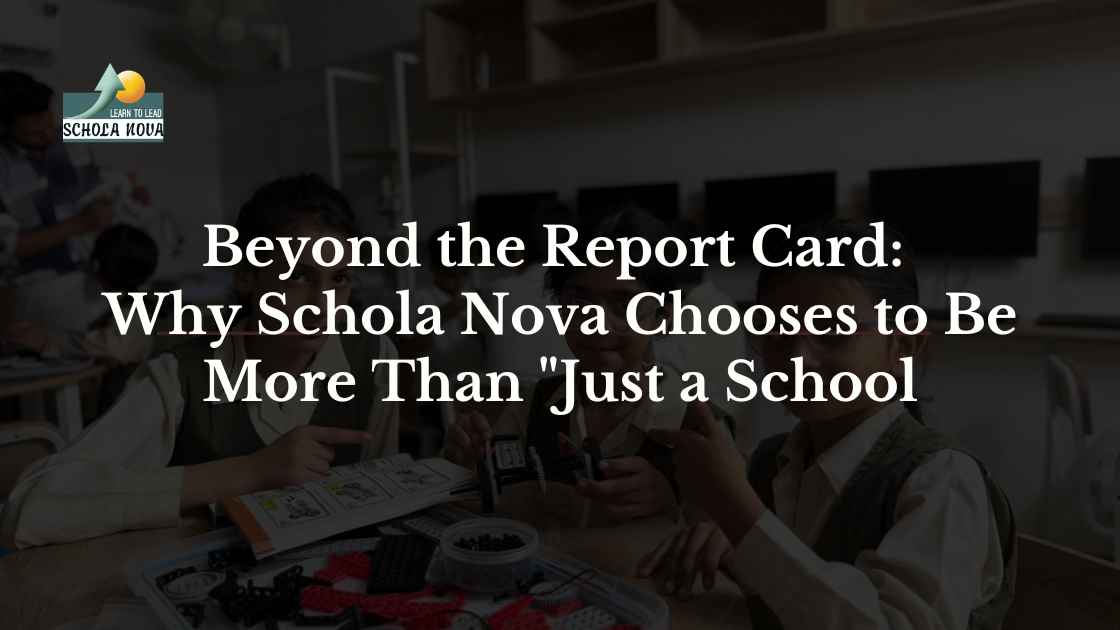
Beyond the Report Card: Why Schola Nova Chooses to Be More Than “Just a School
There is a moment every parent recognises, though it rarely gets talked about.
It happens somewhere in the middle of a school event — a sports day, a competition or a prize distribution — when you catch sight of your child from a distance, not performing for you, just being themselves among their classmates.
Maybe they are cheering loudly for a friend who did not win.
Maybe they are comforting a teammate who dropped the baton in a relay.
Maybe they are standing quietly at the edge of a group, working up the courage to join in.
In that unguarded moment, you are not thinking about their last test score.
You are wondering, quite simply:
Who is this person becoming?
At Schola Nova, we think about that question as much as we think about grades — probably more. It shapes almost everything about our approach to holistic education in Islamabad and how we have built our school in F-8 since 1998.
Our belief is simple:
Education should prepare a child not only to pass examinations, but to participate confidently, responsibly and compassionately in the world.
That means academics matter.
But so do character, confidence, curiosity, communication, creativity, resilience, leadership and relationships.
What Is Holistic Education?
Holistic education looks at the child as a whole rather than measuring development through academic results alone.
A strong education should help students develop intellectually, socially, emotionally, physically and creatively.
This does not mean academics become less important.
Quite the opposite.
Academic knowledge provides an essential foundation. But students also need opportunities to apply what they learn, communicate their ideas, solve problems, work with others, make decisions and learn from setbacks.
UNESCO describes social and emotional learning as developing abilities to understand and manage emotions, build positive relationships, make responsible decisions and handle challenging situations. It connects cognitive, social, emotional and relational development with student wellbeing and academic success.
That thinking closely reflects what we mean by holistic education in Islamabad at Schola Nova.
We want students to leave school with knowledge, but also with the confidence and character to use that knowledge well.
The Question We Ask Ourselves Every Day
Walk into many schools and ask what they are proudest of, and the answer may be predictable: examination results, university acceptances, academic awards and competition victories.
These achievements matter.
At Schola Nova, we take academic performance seriously. Our Cambridge IGCSE programme is designed around academic rigour, critical thinking, independent learning, communication, research and exam preparation.
But if you ask us what we are really proud of, the answer looks different.
It is the student who learned to disagree respectfully in a debate.
It is the student who found their voice on stage after years of shyness.
It is the child who learned to lose gracefully on the sports field and return the next season ready to try again.
It is the student who helped a classmate instead of focusing only on their own success.
These moments may never appear as a separate grade on a report card.
Yet they can shape the person behind the report card.
That is why holistic education in Islamabad is not an additional feature at Schola Nova.
It is part of how we think education should work.
Academics Are the Floor, Not the Ceiling
No one disputes that strong academics matter.
They open doors.
They build discipline.
They develop knowledge.
They prepare students for further education.
This is exactly why our Cambridge IGCSE programme combines academic preparation with critical thinking, independent learning, communication, research and problem-solving.
Cambridge International itself highlights subject knowledge alongside higher-order skills such as problem-solving, critical thinking, independent research, collaboration and presenting arguments.
But academics alone build a transcript.
They do not necessarily build a complete person.
A wholesome personality is made of qualities that rarely appear as a single mark on a report card:
- Emotional intelligence
- Resilience
- Empathy
- Curiosity
- Communication
- Teamwork
- Self-confidence
- Responsibility
- Leadership
- Problem-solving
At Schola Nova, these are not treated as optional extras.
They are part of the wider educational experience.
Our approach to holistic education in Islamabad is therefore built on the idea that academic excellence and personal development should work together.
A student who achieves excellent grades but cannot communicate, collaborate, manage disappointment or show empathy still has room to grow.
Our goal is to help students grow in all these areas.
“Learn to Lead” Means More Than Academic Leadership
Our tagline is:
Learn to Lead.
But leadership is not simply about becoming the captain of a team or winning a competition.
Leadership can mean confidently presenting an idea in class.
It can mean helping a younger student.
It can mean accepting responsibility for a mistake.
It can mean listening when someone has a different opinion.
It can mean remaining calm during a difficult conversation.
And sometimes, leadership simply means learning to manage your own choices.
This is why our philosophy, “Educating with Heart, Leading with Vision,” extends beyond academic achievement.
We want students to understand that leadership begins with character.
What Holistic Education Looks Like at Schola Nova
Personality development is not a single class or a once-a-term event added to a school calendar.
It develops through repeated experiences.
Co-Curricular Activities That Develop More Than Skills
Sports, drama, debate, art, music and other activities provide opportunities for children to discover strengths that academic lessons alone may not reveal.
A child who struggles with mathematics may become a natural leader during a debate.
A quiet student may discover confidence through public speaking.
A student who finds traditional classroom work challenging may become deeply engaged when building, designing or experimenting.
Chess can develop patience and strategic thinking.
Debate can develop communication and confidence.
Sports can teach teamwork, perseverance and healthy competition.
Creative activities can encourage expression and imagination.
These experiences are an important part of whole child education.
Character Built Through Responsibility
Responsibility is easier to understand when children experience it.
Student leadership roles, group projects, classroom responsibilities and peer interaction give students opportunities to discover that being trusted also means being accountable.
When a student is trusted to lead a group project, mentor a younger classmate or take responsibility for a classroom task, they learn something no worksheet can fully teach:
Capability comes with responsibility.
Emotional and Social Development
Academic ability is only one part of a child’s development.
Students also need to understand their emotions, communicate appropriately and develop healthy relationships.
Teachers who know their students well are better positioned to recognise when a child is struggling, becoming withdrawn or finding something difficult.
A supportive school environment can give children space to ask questions, make mistakes and seek help.
Harvard’s Center on the Developing Child highlights the importance of responsive relationships and supportive environments in children’s development. Its resilience research also emphasises supportive relationships and skill-building as important foundations for resilience.
This is one reason holistic education in Islamabad should include both academic support and attention to students’ wider development.
Values in Practice
Respect, honesty and empathy should not exist only as words in a school handbook.
They need to appear in everyday behaviour.
They are developed when students learn to listen to one another.
When they disagree respectfully.
When they help a classmate.
When they accept responsibility.
When they apologise.
When they learn that their actions affect other people.
At Schola Nova, programmes and activities such as life skills, first aid training, grooming and etiquette, Turkish and sign language provide opportunities to develop practical skills alongside academic learning.
Life Skills: Preparing Students for the Real World
Some lessons are difficult to measure through an examination.
How do you communicate when you disagree?
How do you respond when something goes wrong?
How do you work with someone who thinks differently?
How do you take responsibility?
How do you help someone who needs support?
These are life skills.
Schola Nova’s Life Skills Programme gives students opportunities to develop practical abilities that support communication, confidence, responsibility and personal development.
This complements academic learning by helping students think about how knowledge and behaviour translate into everyday life.
Creating Space to Fail Safely
One of the most important parts of holistic education in Islamabad is helping children understand that mistakes are not the end of learning.
A student who is afraid to raise their hand because the answer might be wrong may eventually become afraid to attempt difficult things altogether.
We would rather help students develop the confidence to try.
To make a mistake.
To reflect.
To ask for help.
And to try again.
Harvard’s Center on the Developing Child identifies supportive relationships, adaptive skill-building and positive experiences as important foundations of resilience.
The goal is not to remove every difficulty from a child’s path.
It is to help them develop the skills and confidence to navigate appropriate challenges.
Why Holistic Education Matters More Than Ever
Today’s students are growing up in a rapidly changing world.
They are exposed to more information, more technology and more social pressures than ever before.
Academic achievement remains important, but students also need to communicate, collaborate, think critically, adapt to change and understand different perspectives.
A school that focuses only on examination results risks overlooking some of the qualities students need beyond the classroom.
This is why holistic education in Islamabad matters.
The future will require more than students who can remember information.
It will require young people who can:
- Think critically
- Communicate clearly
- Work with others
- Manage challenges
- Make responsible decisions
- Adapt to change
- Understand different perspectives
- Continue learning independently
These are not separate from academic success.
They can strengthen it.
Preparing Students for a Global World
Education today cannot exist entirely within the boundaries of a textbook.
Students are preparing for a world where collaboration increasingly happens across cultures, languages and perspectives.
At Schola Nova, inquiry-based learning, STEM and STEAM experiences, project work, communication activities and cultural exposure help students look beyond memorisation and towards application.
Our Cambridge IGCSE programme also provides opportunities to develop critical thinking, research, collaboration and communication skills alongside subject knowledge.
The goal is not simply to prepare students for their next examination.
It is to help prepare them for the opportunities and responsibilities that come afterwards.
What Parents Often Notice First
Parents who visit Schola Nova or watch their children grow through our classrooms often notice small moments that say more than a prospectus ever could.
A Child Who Talks About School
A child who comes home talking about a debate topic, a science project, a chess strategy or a robotics activity has experienced something beyond simply completing a worksheet.
They have become engaged.
A Teacher Who Notices the Quiet Days
Sometimes it is not a major achievement that makes a parent feel connected to a school.
It is a teacher noticing that a normally talkative child has been unusually quiet.
That attention can tell families that their child is being seen as an individual.
A Child Who Wants to Keep Learning
When students begin developing interests outside their required subjects, education starts becoming personal.
A child may discover an interest in robotics.
Another may love public speaking.
Another may become passionate about sport, art or science.
This discovery is one of the valuable outcomes of holistic education in Islamabad.
A Student Who Can Say, “I Got It Wrong”
Perhaps one of the most important signs of growth is the ability to admit a mistake without feeling that the mistake defines you.
A student who can say, “I got it wrong,” and then ask, “What can I do differently?” is developing a skill that extends far beyond school.
How Our Approach Develops at Different Stages
A five-year-old and a seventeen-year-old need very different forms of support.
That is why our approach develops alongside students.
Early Years: Play, Laugh, Learn
In the preschool years, structured play and exploration help children develop their earliest sense of competence.
They discover that they can build something, solve something, create something and complete something independently.
These small achievements become foundations for confidence and curiosity.
Research and guidance from UNICEF emphasise that play supports children’s cognitive, physical, social, emotional and creative development.
Primary School: Discover, Explore and Participate
As children move into primary school, hands-on learning and practical experiences provide opportunities to explore ideas rather than simply memorise information.
Co-curricular opportunities such as chess, art, public speaking and introductory technology activities allow children to discover their interests and strengths.
You can explore Schola Nova’s Primary School programme to learn more about this stage of learning.
Secondary School: Challenge, Evolve, Excel
As students become older, their responsibilities increase.
They face more complex academic expectations while developing communication, leadership and decision-making skills.
Debate, public speaking, life skills, practical training and co-curricular activities complement their preparation for Cambridge IGCSE examinations.
You can also explore the Secondary School programme and learn more about the opportunities available as students progress through the school.
Learning Through Play and Exploration
For younger children especially, education should not be reduced to worksheets and memorisation.
Play gives children opportunities to explore, experiment and understand the world around them.
UNICEF explains that play can support problem-solving, communication and the development of social, emotional and cognitive skills.
This is why an effective holistic education approach gives young children room to explore while providing appropriate structure and guidance.
At Schola Nova, early learning is designed to encourage children to participate, discover and develop confidence as they learn.
An Institution, Not Just a School
The word “institution” carries weight for a reason.
An institution has an identity.
A philosophy.
A promise.
A sense of continuity.
That has always been our ambition at Schola Nova.
Not to be a place students simply pass through on their way to somewhere else, but a place that contributes meaningfully to who they become.
This is what “Learn to Lead” means to us.
Leadership is not only ambition or achievement.
It is character.
It is self-awareness.
It is integrity.
It is the ability to make responsible decisions even when nobody is watching.
That kind of development takes more than a curriculum.
It requires a school community that genuinely cares about the person behind the grades.
A Community, Not Just a Curriculum
For many families, choosing a school is not simply about comparing examination results.
It is about trust.
Parents want to know:
Will my child be noticed?
Will they be encouraged?
Will their strengths be recognised?
Will they be challenged appropriately?
Will they learn to work with others?
Will they develop confidence?
Will they feel that they belong?
These questions are central to the idea of holistic education in Islamabad.
At Schola Nova, we believe a strong school community should work alongside families to support children’s academic, social and personal development.
Our approach combines academic learning with life skills, leadership, co-curricular opportunities, sports and practical experiences.
Parents can explore our academic programmes to see how the educational journey develops from early years through Cambridge IGCSE.
Learning Beyond the Classroom
Some of the strongest lessons happen outside a traditional classroom.
Sports can teach teamwork.
Outdoor activities can build confidence.
Competitions can teach students how to handle success and disappointment.
Group projects can develop communication.
School events can create a sense of belonging.
Schola Nova’s outdoor activities provide opportunities for students to participate, work with others and develop confidence beyond traditional classroom learning.
These experiences form an important part of a broader holistic education in Islamabad.
Why Parents Should Look Beyond the Report Card
A report card can tell you something important about a child’s academic performance.
But it cannot tell you everything.
It may not tell you whether your child:
- Helps a classmate who is struggling.
- Can communicate an idea confidently.
- Handles disappointment with maturity.
- Knows how to work as part of a team.
- Has the courage to try something unfamiliar.
- Can accept responsibility for a mistake.
- Knows how to disagree respectfully.
- Has discovered something they genuinely love learning about.
These qualities matter.
They matter in university.
They matter in careers.
They matter in friendships.
And they matter in life.
That is why our understanding of holistic education in Islamabad goes beyond adding more activities to a timetable.
It means creating an environment where academic learning and personal growth reinforce one another.
More Than “Just a School”
A wholesome personality is not something a school hands a child on results day, folded neatly inside an envelope alongside their grades.
It is developed gradually.
Through classroom conversations.
Through friendships.
Through sports.
Through competitions.
Through mistakes.
Through responsibilities.
Through teachers who notice.
Through opportunities to lead.
Through moments when a child succeeds.
And through moments when they do not.
Academics are, and will always remain, the foundation of what we do at Schola Nova.
But a foundation alone does not make a complete building.
Education should build knowledge.
It should build confidence.
It should build character.
It should build curiosity.
It should build resilience.
It should help children understand themselves and the world around them.
That is what we mean by holistic education in Islamabad.
Frequently Asked Questions About Holistic Education
What is holistic education?
Holistic education focuses on the development of the whole child. Alongside academic knowledge, it supports areas such as emotional development, communication, confidence, creativity, physical wellbeing, teamwork, leadership and character.
Why is holistic education important for children?
Children need more than academic knowledge to navigate school, university, careers and relationships. Holistic education gives students opportunities to develop practical, social and emotional skills alongside their academic abilities.
Does holistic education reduce academic focus?
No. Holistic education does not mean lowering academic standards. Instead, it combines academic rigour with opportunities for students to develop communication, critical thinking, resilience, leadership and other skills.
How does Schola Nova provide holistic education in Islamabad?
Schola Nova combines academic programmes with life skills, sports, co-curricular activities, leadership opportunities, practical learning, communication activities and character development.
How does Cambridge IGCSE support student development?
Cambridge programmes combine subject knowledge with transferable skills including critical thinking, problem-solving, collaboration, independent research and communication.
What role do co-curricular activities play in education?
Co-curricular activities give students opportunities to discover interests, build confidence, work with others, develop leadership and learn how to manage both success and disappointment.
Is holistic education suitable for younger children?
Yes. Holistic development begins from the early years. Play, exploration, communication, creativity and social interaction help young children build confidence and curiosity. UNICEF’s child-development resources highlight the importance of play in supporting children’s wider development.
How can parents support holistic development at home?
Parents can encourage children to explore interests, take responsibility for age-appropriate tasks, communicate openly, participate in activities, learn from mistakes and develop healthy relationships.
Our Door Remains Open
A wholesome personality is not created in a single class.
It develops through hundreds of small experiences.
A child discovering that they can speak confidently.
A student learning to accept a mistake.
A teammate encouraging someone else.
A young leader taking responsibility.
A teacher noticing when something has changed.
A parent seeing their child become more